How to Kickstart a Movement with Facebook Ads and Mass Calls
This webinar was recorded in October 2017. Our strategy and tactics recommendations may have changed since the webinar was recorded.
Watch this webinar recording to learn how a small nonprofit law center used a few thousand dollars in Facebook ads and mass conference calls to build a movement to expand Medicaid in Tennessee.
You’ll get the inside story of what worked and what didn’t and get ideas for tactics to try in your own work.
The ladder of engagement model presented in this webinar — Facebook content to mass call to offline action — has been used successfully by several organizations working at state and national levels and with different demographics (youth, undocumented people, people in rural Appalachia, etc). Read how IfNotNow and Movimiento Cosecha have used the model to scale their work.
Presenters
Katie Alexander is the former Field Director at the Tennessee Justice Center, a small non-profit law firm that helps Tennesseans access health care coverage. Originally from New York state, Katie got her degree in Literature and the African Diaspora at American University in DC, and then moved down to Nashville.
Randall Smith is the founder of PowerLabs. He specializes in helping clients use design thinking processes to create, launch and run leaderful, open source campaigns.
Resources
If you are new to Facebook ads, get started with the following learning resources.
Keys to Success: Webinar for Facebook Advertisers - This free webinar from Jon Loomer is the best place to start to learn Facebook ad strategy.
Facebook Blueprint - free online courses directly from Facebook
Ad Content
Our process to create ad content starts creating audience personas to help us think through the needs and desires of our audience and the images and messages that might appeal to them. We also work backwards and create audience personas from an organization’s existing Facebook fan base to guide content creation.
We then review messaging guidance from the Opportunity Agenda, the Center for Community Change and ASO Communications. Sign up for our newsletter to get the latest messaging guidance and research.
We also look at the language used by journalists covering the issue in the outlets that our target demographics consume. News coverage is a great way to get ideas on how to talk about an issue in a way that is understandable by our target demographics.
Our favorite stock photo sites
Lightstock is a stock photo service for churches. It’s a good source of images to represent house meetings, small group organizing and mass meetings.
Once we have ad text and images we start to test.
Facebook Ad Targeting
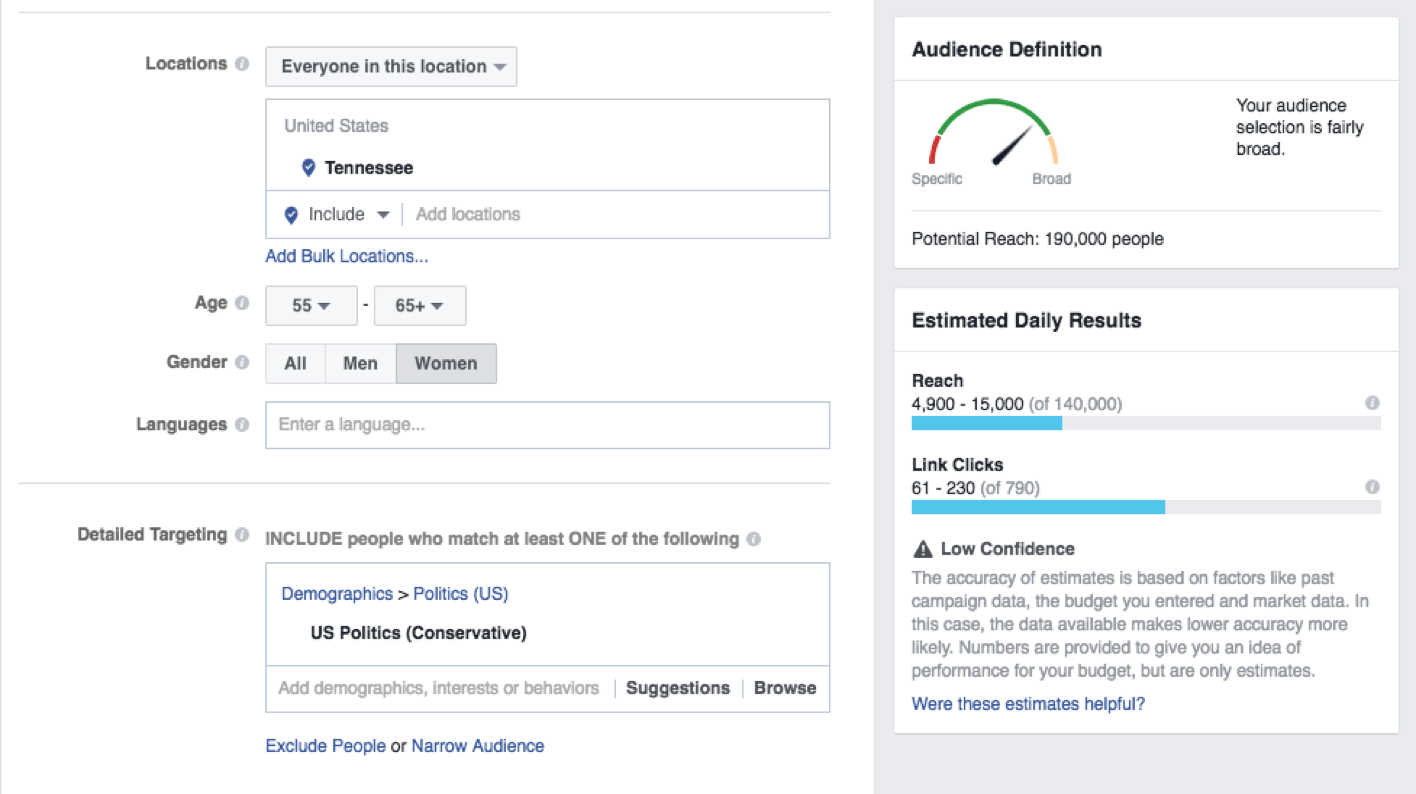
We used interest targeting for this ad campaign -- primarily targeting women 55+, US Politics, Conservative. We also used some of the advanced methods laid out in this guide to interest based targeting.
Interest based targeting works great if you are trying to reach people who are not like your current supporters.
If you already have contact info for 500+ people who match your target demographics you may want to use lookalike audience targeting instead. We typically get our best results by starting our ad targeting with lookalike audiences and value based lookalike audiences.
We amplified our email asks during the campaign by serving ads to our own supporter file with the same ask. We learned this tactic from an experiment ran by the Michelle Nunn for Senate campaign, Trilogy Interactive and Facebook. This Facebook email amplification experiment [PDF] raised $2.20 for every dollar spent on a $15,000 ad buy.
Testing Facebook Content
We used this split testing method to find a winning ad image and text during the initial Insure Tennessee campaign sprint. Our tests weren’t perfect. We had to quickly find winning content and didn’t allow some ad variations to run long enough to get statistically significant results.
We now prefer to use Facebook’s new ad split testing feature and let tests run between three and 14 days for best results. Learn how to use it from Jon Loomer.
Since running this campaign we’ve found that optimizing the following design elements leads to the biggest gains:
Image
Headline
Post text
Placement
Recent tests we’ve run with have found that longer post text (80-100 words) out performs shorter text. Give it a try and let us know if it works for you.
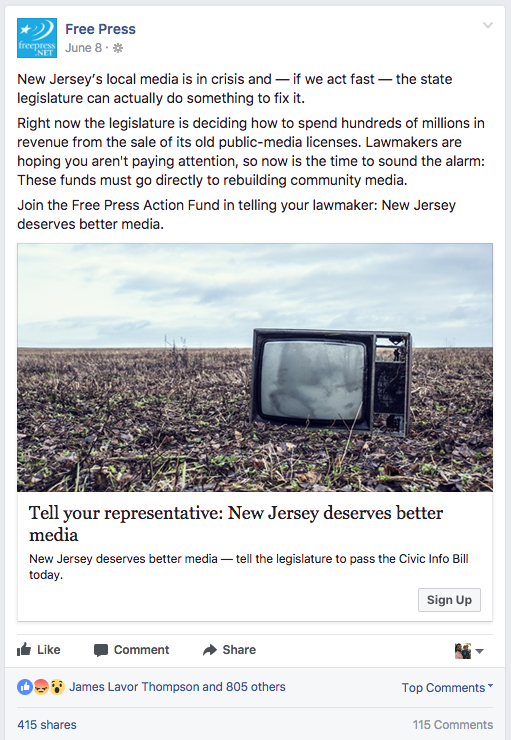
The lead-in text on this ad is 85 words and out-performed ad variations with 22 words and 40 words. The image of a TV in a field out-performed variations with photos of people.
A landing page that uses the principles of conversion centered design is key. If your landing page is terrible you’ll burn money driving traffic to a landing page that no one completes.
Facebook Lead Generation Ads
Facebook Lead Generation ads are a new method to recruit supporters. People can opt-in to your email list without ever leaving Facebook. Removing the friction of leaving Facebook can drastically reduce acquisition costs.
One organization that attended Randall’s online course on Facebook lead generation ads cut their cost per sign-up by 30% on a $200,000 ad campaign.
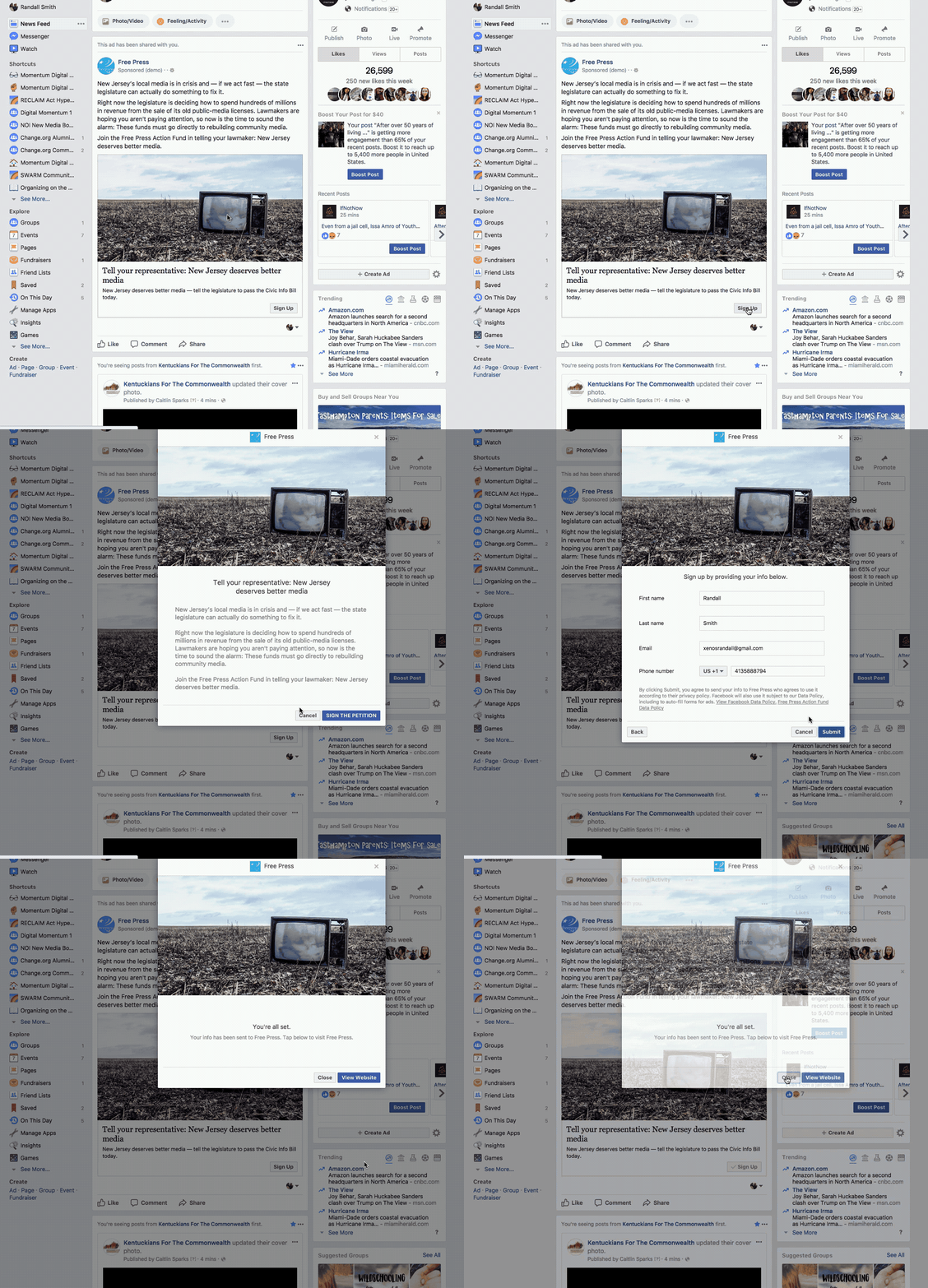
Jon Loomer has a free ebook with step-by-step instructions for creating lead ads. His list of potential problems with lead ads is out of date though. Jon covers some of the new features here.
Pro tips for creating lead generation ads:
The default name field is first and last names in a single form field. Choose the separate first and last name fields option to make importing (or syncing via API) to your CRM easier.
Requiring phone number will likely increase your cost per acquisition. The increased cost will be offset by increased action rates if you follow-up by text messaging (peer-to-peer or broadcast) and/or phone calls. Learn how Cosecha uses peer-to-peer texts to move people from Facebook content to local organizing in this webinar recording with Thaís Marques.
Learn more about using lead generation ads to recruit people and raise money in this webinar recording.
Mass calls
We primarily use MaestroConference or Zoom as a platform for mass calls. We prefer to use calls over a webinars because they are more accessible to people in rural areas, people without computers and people without high speed internet access.
This wasn't mentioned in the webinar, but a key tactic for mass calls is to break people up into small group conversations and then ask people to make action commitments. These two tactics can increase the percentage of people who will lead or participate in follow-up activities.
Learn how more on how to incorporate mass calls into a cycle of actions and get a sample call agenda.