
Swarm Teams: Designing for ownership and follow-through at trainings
Sophia Zaia | September 2026
This is an excerpt from Breadth and Depth, the PowerLabs newsletter. Sign up below to get the next edition in your inbox.
Earlier this year I helped facilitate a Momentum training for Nordic climate activists in Copenhagen.
Momentum has a tradition of setting up “swarm teams” at their trainings: temporary teams of participants that take ownership over key functions for the duration of the program—from space cleanliness to meal set up to planning fun energizers for when people need a pick-me-up.
This time, we changed how we launched the teams, bringing in some of the research we teach in Nerdy Movement. We used an agenda based on the fast team formation protocol developed by team-effectiveness scholars Ruth Wageman and Richard Hackman to help emergency medical teams operating together for the first time. New teams suffer from what they call the liability of newness—they coordinate worse, make more mistakes, and catch far fewer of those mistakes. (In one NTSB review of major airline accidents, nearly half occurred on the crew's very first flight together — and almost three-quarters on their first day.) But teams that spend just 10 minutes on intentional formation make radically fewer mistakes, catch the ones they do make, and surface more of the voices in the room who can help.
This is what participants had to say about it:
“The practical exercise with different teams was a great meta way to learn about organizing.”
“I loved the swarm teams being such a big part of the training and everyone having a role.”
“Great with swarm teams. Ingenious to train us in using them through the course.”
“The vibes team really helped to create a joyful and comfortable environment.”
What we tried
We wanted the organizers to experience what it’s like to work in well-structured teams and conduct team launches because the research shows well-designed teams do better work, are more likely to improve in their strategy over time, and result in better experiences for team members. Having the team get on the same page about their goals, norms for how they’ll work together and roles during their first meeting makes this more likely to happen.
Here’s the agenda. We’ve used it for public facing trainings like this one, and for internal trainings with groups.
Introductions: name, why you joined this team, any special skills, experiences or passions you have that could help the team achieve its purpose (6 minutes)
Review/revise the draft purpose of the team (2 minutes. Don’t get stuck here.)
Team norms: what should we always do, never do, how will we stay in touch? (6 minutes)
What requests do we have for the group? (4 minutes)
Remaining questions or concerns (2 minutes)
Team name & chant (5 minutes)
The results
I was blown away by the creativity and the 150% ownership and creativity the teams took filling their roles.
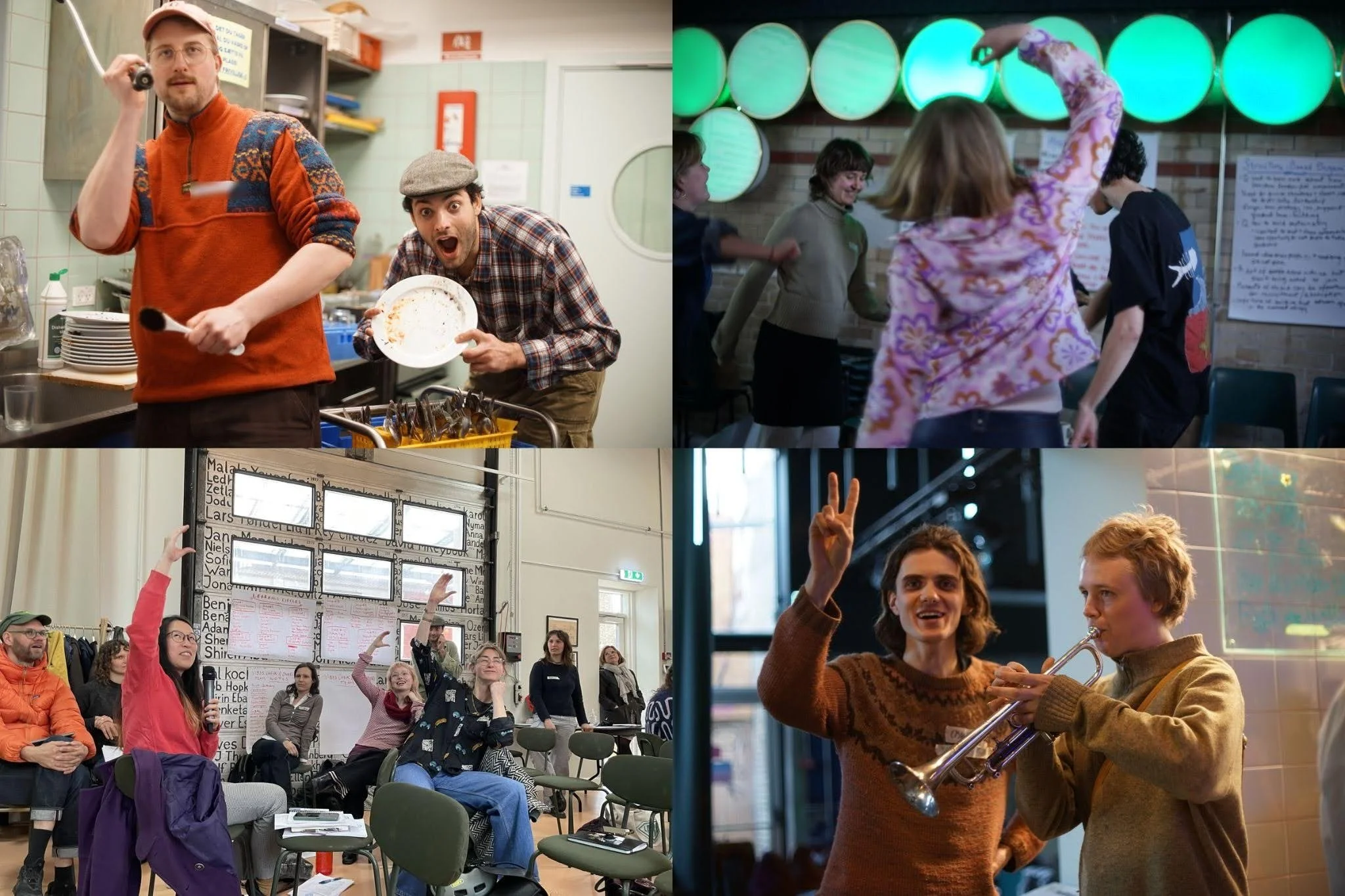
Some highlights: A member of the Timekeeper team brought an instrument from home on day 2 to make the time reminders beautiful and hilarious.
During a day with too much sitting the Space Prep team changed the seating arrangement into two lines of nested cup shapes so we could see each others’ faces and the slides, which got rave reviews.
Meal Support didn’t just keep all the meals on time and tidied up—they also created a system to communicate about ingredients and prevent food waste.
And a Vibes Team DJ organized not one but two sober dance parties.
Not to mention these gorgeous photos taken with consent by the Photography Team!
Why is it worth the training time?
It’s good pedagogy to have people try something in a training, not just hear about it. They build the skill by experiencing what they’re preparing to replicate on their own in the real world, and they build ownership over the training environment.
Imagine we’d skipped the team launch. The space gets messier each day, people arrive late, snacks run out, no one plans an energizer after lunch. It would be easy to write this off as "problem participants," but that's the fundamental attribution error: blaming a person's character for what's actually a product of the conditions you designed. Redesign the conditions, and you get better outcomes.
Structure and autonomy
You don't have to choose between giving people structure and giving them autonomy. Studies of classroom engagement find people engage most when you offer both.
What we found worked: giving the team clear steps, a rationale for the activity, and the information they needed to succeed (like how many members per team, a draft purpose to react to, and a trainer point person if they had questions), with real choices built in they got to own: (revising that purpose, setting their own norms, naming their team, and writing a chant). Getting the balance right can mean the difference between people just waiting for direction vs taking their own initiative, feeling supported to act autonomously within a clear domain of responsibility.
About the author
Sophia Zaia
Prior to joining Randall at PowerLabs, I worked for five years with the Sunrise Movement, doing local and distributed electoral organizing.
In 2020, I built a voter contact program with fifty volunteers aged twelve to their early twenties across six teams. This program organized thousands of volunteers to make six million dials and send one million postcards for progressive candidates.
I also served on the senior leadership team at Sunrise, where I supported leadership teams as they aligned on their purposes, goals, and work practices.
I’ve worked on electoral campaigns from the inside and out, leveraging the youth vote in support of Kendra Brooks’ and Nicolas O'Rourke's at-large city council races in Philadelphia, and working as deputy field director on Jessica Cisneros’ 2022 campaign for Congress.
At PowerLabs, I co-coordinate Nerdy Movement, our six-week training for organizers, and have supported:
The team at Vot-ER in resetting their team purpose and work practices, formalizing their decision-making processes, developing cadences for planning and strategizing, and using new approaches to ensure the team draws on its members' diverse knowledge, skills, and experiences,
Organizers at the Sunrise Movement on designing their 2024 distributed and decentralized voter contact programs,
Organizers at Leadnow to design a relaunch of their organizing program, and
The Organizing Director and Executive Director of the Red-Green Party of Copenhagen on designing a year-round small group organizing program. Check out our webinar on the program.
I am currently becoming ICF-certified as a leadership coach through the Brown University School of Professional Studies’ Leadership Performance Coaching Certification program.
I offer:
Consulting support to organizers designing leader-full organizing programs or interested in building teams that learn, adapt, have fun and do excellent work,
And leadership coaching to organizers looking to explore what’s next in their leadership journey, confront persistent challenges, address burnout, or simply looking for a partner to champion their growth, learning and problem solving along the way.